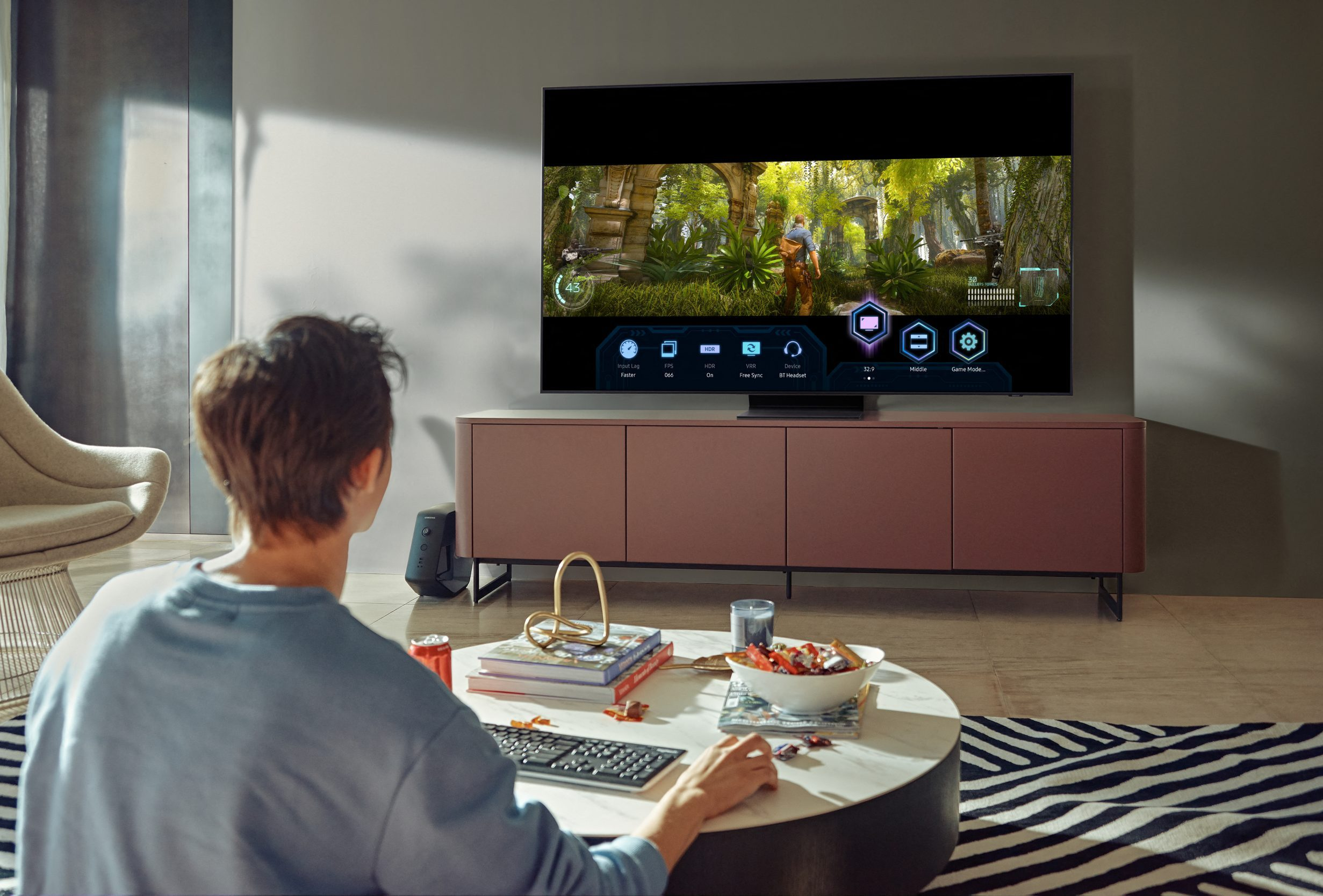
The gaming industry is undergoing a very interesting “split evolution.” If you’ve been following the gaming ecosystem for a long time, you’ll clearly feel that it’s splitting into two seemingly opposing paths—one is pursuing a “cloud-based future,” trying to make hardware gradually invisible; the other is like engaging in a “performance arms race,” constantly pushing the limits of physics and making local devices increasingly powerful.
When you sit in your living room, looking at the latest Samsung Neo QLED or OLED TV, its built-in Samsung Game Hub might give you the illusion that
“consoles are becoming obsolete?”
Simply connect your controller and open the app, and you can play AAA titles like Halo, Cyberpunk 2077, and FIFA directly in the cloud, without needing an Xbox, PS5, or tens of gigabytes of content. The ease of “no loading, no updates, no console required” is truly appealing. When I first tried it, I even felt like I was experiencing a future beta version.
But the problem is:
the future is bright, but the laws of physics don’t lie.
Latency still exists, bitrate remains limited, and competitive gamers will never tolerate such “subtle stuttering.”
For players who crave native 4K, 240Hz refresh rate, and 1ms response time, cloud gaming is more of a “convenient supplement” than a “primary weapon.”
This is precisely why another path— the “hardware extremes” represented by
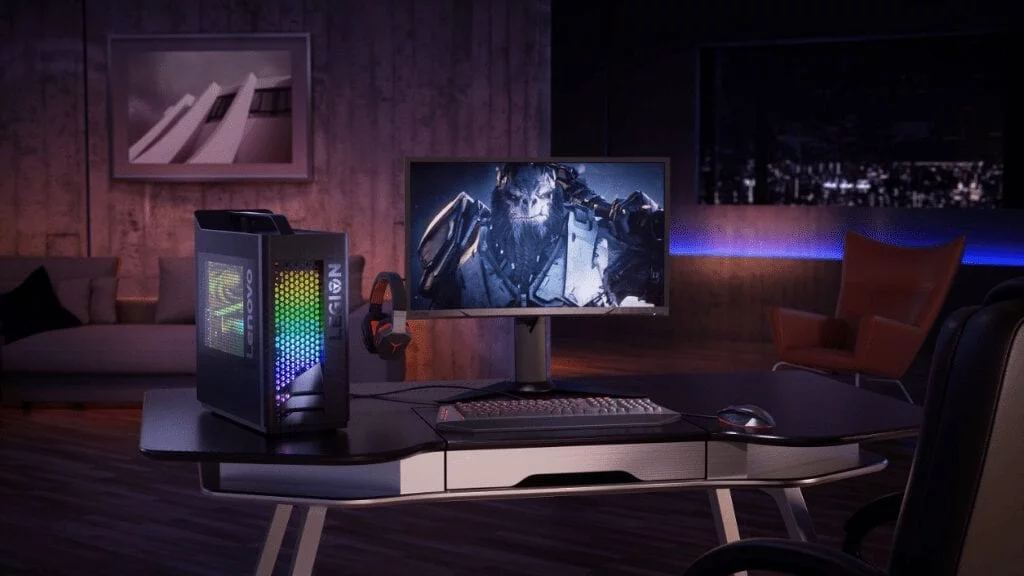
the Lenovo Legion series —still firmly holds the hearts of high-performance gamers. The logic behind these devices is simple: I handle the computing power myself, I provide the frame rate myself, and I handle the image quality myself.
These two experiences, seemingly parallel, are both vying for the player’s future. So what are their fundamental differences? I’ll break down these two ecosystems based on my own experience.
I. Samsung Game Hub: The Art of Simplifying the Complex
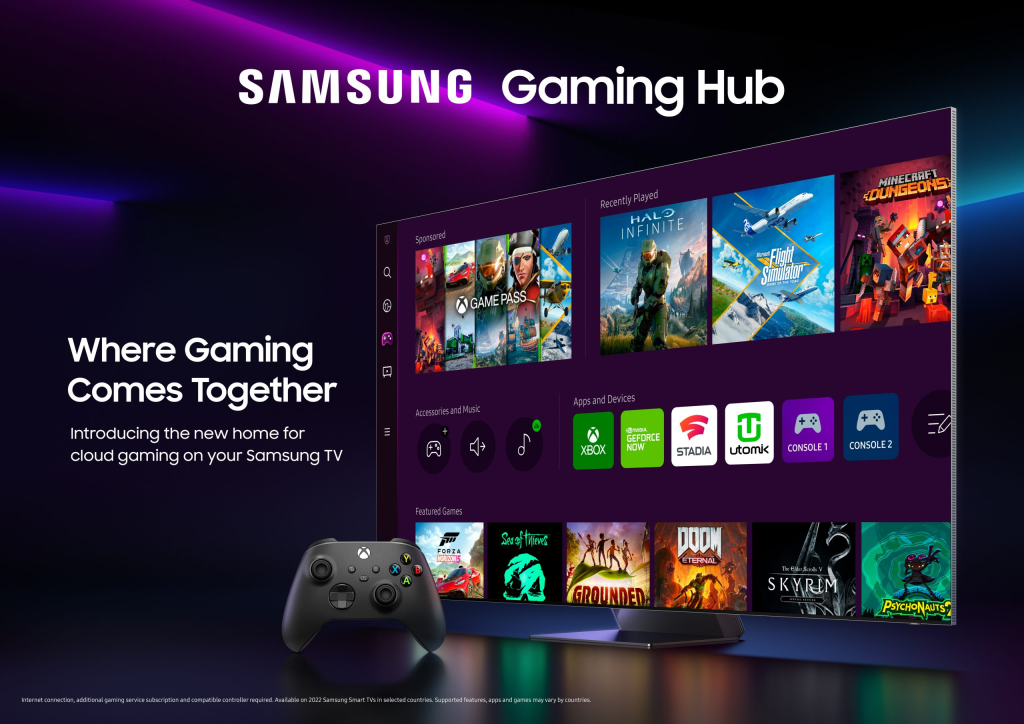
The core philosophy of Samsung Game Hub is a very “minimalist” aesthetic—eliminating all hardware dependencies and retaining only the shortest path between you and the game.
1. A truly authentic “wireless console experience”
This is truly revolutionary. Game Hub integrates it directly:
Xbox Cloud Gaming
NVIDIA GeForce Now
Amazon Luna
Utomik and other cloud service platforms
I remember the first time I tried Game Hub at a friend’s house, he turned on the TV and just said, “Let’s play a game of FIFA.”
And in less than 10 seconds, the game was already running.
No need to move servers, no need to update versions, no need to wait for downloads.
This is the most direct charm of cloud gaming— the barrier to entry is almost zero.
2. Samsung has strong ecosystem integration capabilities.
Samsung has integrated Game Mode, low latency technology, color optimization, and HDR pipeline into the underlying layer of Game Hub.
When you switch from Netflix to gaming, it automatically enters low-latency mode, optimizing picture color, contrast, and audio latency. This “one-click switching” experience perfectly aligns with the core requirement of the living room setting: ease of use .
For casual gamers and family entertainment enthusiasts, Game Hub is almost the perfect solution.
II. Lenovo Legion Ecosystem: Maximizing Addition
If Samsung wants to use the cloud to “simplify everything,” then Lenovo Legion takes a completely different extreme approach: pushing hardware performance to its limits .
As a long-time user of Legion desktops, laptops, and even the recent Legion Go handheld console, I am particularly aware that what makes this ecosystem truly attractive is not its “quantity,” but its “strength.”
1. The value of local computing power is underestimated.
Even with its speed, cloud gaming still faces two unavoidable problems:
Image compression due to bandwidth limitations
End-to-end delay (especially input delay)
Legion’s advantage lies in its near-total dominance in these two areas.
equipped with an RTX 40 series graphics card and an Intel Core HX processor , cannot replicate the sharpness, shadow depth, and volumetric lighting of a native 4K ray-traced game like Cyberpunk 2077. Cloud gaming simply cannot capture that level of detail.
In FPS games like CS2 and Valorant, competitive players are far more sensitive to latency than the average person. If the latency increases from 20ms to 40ms, they can immediately feel that “the gun is heavier” or “the crosshair is drifting.”
Legion’s high refresh rate screens (240Hz, 360Hz, and even 500Hz), combined with local computing power, can amplify this difference infinitely.
Not to mention the Legion Coldfront cooling system , which is more stable than many other brands in the same class in terms of sustained performance.
2. Legion Arena / Legion Space: The software ecosystem is not as weak as it used to be.
Previously, people were skeptical about “PC brands building an ecosystem,” but Legion’s software has indeed done a good job in the past two years:
Legion Arena : Integrates Steam, Epic, Xbox, and Ubisoft Connect
Legion Space : A game center optimized for handheld consoles
Account cloud synchronization, lightweight interface, and intelligent driver optimization are all more unified.
Especially the Lenovo Legion Go handheld console; I could play “The Legacy of Hogwarts” directly on a plane without needing an internet connection. This is something the Samsung Game Hub can never replace.
III. Core Comparisons in terms of user experience: Image quality, latency, and immersion
It becomes clearer if we compare the two on the same level.
(1) Image quality comparison
Samsung Game Hub
Due to limitations in cloud bitrate, 4K streaming is often “fake 4K”.
High-speed camera movements may produce pixelation and color blocks.
Brightness and contrast will decrease due to compression.
Lenovo Legion
Native rendering: Ray Tracing, DLSS 3.5, Frame Generation
The level of detail achieved by real-time ray tracing is something cloud gaming simply cannot match.
The upper limit is extremely high: it depends on your graphics card, not your internet speed.
Simply put:
cloud gaming graphics “look very clear”, while local graphics are “true high definition”.
(2) Delayed experience
Samsung Game Hub:
End-to-end latency is typically 50–100ms
No problem playing RPGs, SLGs, and story-driven games.
But when playing fighting games, FPS games, or rhythm games, there will always be that “momentary lag”.
Legion:
Nearly zero latency
When the mouse moves, the screen “follows” it.
The experience of FPS/competitive games is vastly different.
That’s why I say:
cloud gaming is for entertainment, while local gaming is for winning.
IV. Differences in target users: Which category are you?
When I consulted some players, I clearly found that the two types of users were completely different.
Users who prefer Samsung Game Hub:
I don’t want to buy a console
Want to make the living room cleaner
Family entertainment first
Mostly casual players
I like to drive and play whenever I want, and I don’t want to go through all the hassle.
Users who prefer Lenovo Legion:
FPS / Competitive Players
I like the ultimate image quality
Pursuing native 4K, 240Hz, and 1ms response time
Extremely sensitive to latency
I enjoy tinkering and optimizing frame rates.
For applications requiring long-term computing power (e.g., video editing, 3D animation).
These two types of players are not actually in competition— they are target users of different ecosystems.
V. Future Trends: Will the two paths merge?
Interestingly, cloud gaming and local gaming are not mutually exclusive; rather, they are more complementary.
When you want to play FIFA easily, Game Hub is unbeatable.
When you want to seriously climb the ranks, you’ll definitely open Legion.
When you’re on a plane, in a remote area, or in a coffee shop, Legion Go becomes the only option.
The more likely trend in the future is that
“cloud + local” will become the dual-system mode for players.
The “lightweight experience” represented by Samsung will only get better and better,
and the “ultimate experience” represented by Lenovo will not disappear.
Final conclusion
If I were to explain it in one sentence:
Samsung Game Hub is “the convenient future,” while Lenovo Legion is “the powerful present.”
I’ve used both ecosystems; they don’t replace each other, but rather complement each other.
Want to play games easily in your living room? Game Hub.
Want to pull off amazing plays in an FPS game? Legion.
Want to take it with you and play with it? Legion Go.
If you’re choosing your “primary gaming platform,” I’d still recommend the Lenovo Legion . Not because it’s trendier, but because:
Stable, powerful, controllable, and with negligible latency.
These are all hard hurdles that cloud gaming will still find difficult to overcome in the foreseeable future.