
Introduction: When talking about Korea, why can’t we avoid Chaebol ?
When talking about South Korea, many people may first think of K-pop stars, world-leading plastic surgery technology, or those movies that deeply expose social problems. But no matter which aspect you focus on, as long as you talk about the fundamental structure of Korean society, you can’t avoid a keyword – Chaebol (Chaebol) .
These Chaebol Groups not only control the economic lifeline of South Korea, but also have a profound impact on politics, military and even the daily lives of ordinary people. In 2024, the total revenue of the top five Chaebols in South Korea – Samsung, SK, Hyundai, LG and Lotte – reached a staggering 102.5 trillion won, accounting for almost half of the country’s GDP. And the king among them is none other than Samsung.
Samsung’s business covers electronics, finance, heavy industry, chemicals and other fields. From the Burj Khalifa in Dubai, the Petronas Twin Towers in Kuala Lumpur to Taipei 101, Samsung is behind many world-class buildings. In South Korea, Samsung is everywhere:
people are born in Samsung hospitals, study in schools funded by Samsung, use Samsung phones for work, use Samsung credit cards for consumption, live in Samsung real estate houses, go to Samsung nursing homes when they are old, and even when they are cremated, there are funeral homes operated by Samsung…
It can be said that from babies’ diapers to the elderly’s coffins, Samsung has penetrated every detail of Korean life.
But the question is: How did South Korea, which was still an agricultural country in the 1940s, develop such a strong Chaebol system in just a few decades? How did Samsung, a company that started out as a farmer, get to where it is today?
Lee Byung-chul: Founder of Samsung Empire
An extraordinary farm boy
In 1910, a rural family in South Gyeongsang Province, South Korea, welcomed their fourth child, Lee Byung-chul. Although they lived in the countryside, Lee’s family was not an ordinary farmer: his father was a well-known local gentry, and his grandfather was a scholar who valued education and even built the first private school in the village.
Lee Byung-chul was smart and curious since he was young, and his family background gave him a better starting point than his peers. But he was not satisfied with the boring Chinese characters and Confucian classics in the private school, and he wanted to get in touch with a newer world – at that time, various “new-style schools” were emerging in South Korea, which not only taught cultural courses, but also told world stories and modern technology.
With his excellent persuasive ability, Lee Byung-chul successfully convinced his parents to go to Hancheng (now Seoul) to study, starting a broader life.
The dream of studying in Japan: an unfinished journey
At the age of 20, he set his sights on Japan, the most advanced educational center in Asia at the time. Universities such as Tokyo Imperial University and Waseda University were the dream schools of countless East Asian elites.
Although his family strongly opposed it, especially considering that he had married early and had a family, Lee Byung-chul still insisted on his decision. With his own savings and the help of his friends, he boarded a ship to Japan alone and started a “runaway” study abroad journey.
In 1930, he was admitted to Waseda University and began systematic economic studies. But fate once again disrupted his plans – in the second year, he had to return home for treatment due to severe beriberi.
His dream of studying abroad was interrupted and his academic qualifications were incomplete. After returning to China, he fell into the lowest point in his life.
From decadence to awakening: the starting point of entrepreneurship
After returning to Korea, Lee Byung-chul had nothing to do for a while and was addicted to playing cards and drinking. But late one night, when he came home drunk and saw his wife and children sleeping, he was suddenly struck by a sense of responsibility: if he continued like this, his life would be completely ruined.
From that day on, he decided not to waste his time any more and began to think about the direction of his career. This change of mind became the starting point of the legendary story of Samsung Group.
South Korea’s Chaebol : Historical Opportunity and Personal Ambition
War and reconstruction: Economic vacuum gave rise to Chaebol
World War II and the Korean War almost wiped out South Korea’s original capitalist class. Many wealthy businessmen fled overseas, leaving behind an economic vacuum.
In this context, emerging entrepreneurs like Lee Byung-chul received strong support from the government. In order to rebuild the economy, the South Korean government took the initiative to support a group of courageous and capable entrepreneurs, providing financial and policy support to promote the industrialization process. These companies eventually grew into today’s Chaebol Group.
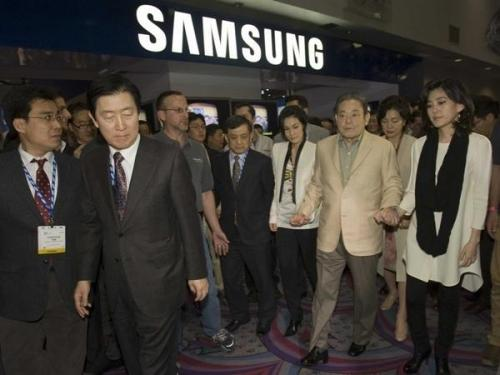
Samsung: From a trading company to a global giant
Samsung was originally just a small company engaged in the trade of rice, dry goods and fishery products. With his keen market insight, Lee Byung-chul expanded Samsung step by step.
In the 1950s and 1960s, he expanded the business to textiles, chemicals, and electronics, gradually forming a group structure. In the 1970s, Samsung entered heavy industry and semiconductors and officially entered the international market.
Samsung’s expansion has never been just for the purpose of making money, but rather a combination of Lee Byung-chul’s sentiment of “national rejuvenation” and personal ambition.
Conclusion: Samsung is just the beginning, the Chaebol phenomenon is still ongoing
Samsung’s influence remains unrivalled in South Korea today, but the bigger question is: Has Chaebol ‘s power become too concentrated?
Samsung’s success story is certainly admirable, but Chaebol ‘s deep involvement in South Korea’s politics and economy has also caused concerns from the outside world.
Perhaps, Korean society needs to rethink: Will the future Korean economy continue to be dominated by Chaebol , or will it move towards broader entrepreneurial diversification?
What do you think of the story of Samsung and South Korea’s Chaebol ? Is it an industrial miracle or a hidden danger? Please leave your opinion in the comments section.